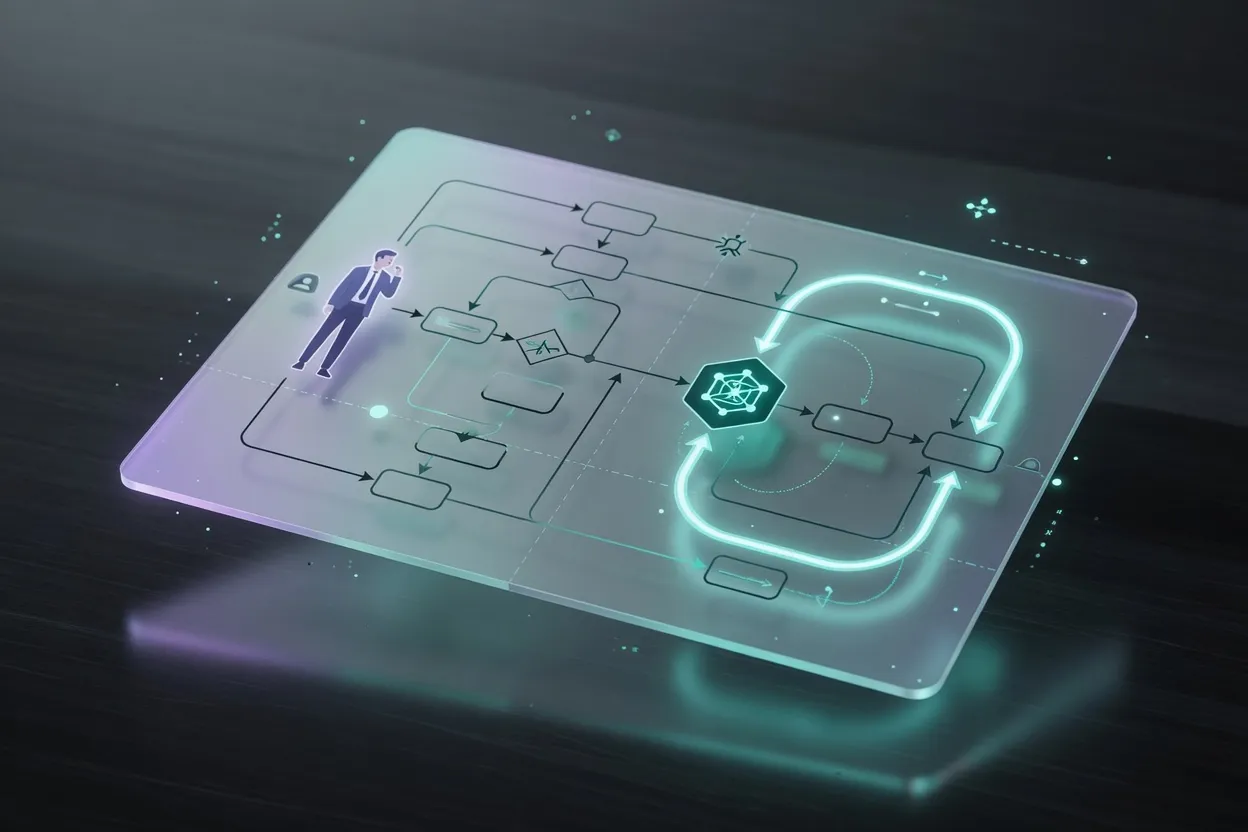
Agentic tasks in BPMN diagrams
The problem: BPMN wasn’t built for AI agents
BPMN is the standard for modeling business processes — human tasks, service calls, gateways, message flows. It assumes every participant is a person or a deterministic system.
AI agents are neither. They are non-deterministic, they need reflection loops, they produce outputs with varying confidence, and they collaborate in patterns that don’t map cleanly onto classic BPMN. Drop an agent into a swim lane and the diagram still tells you almost nothing about how that agent works, how reliable it is, or how several agents should coordinate.
As work moves from AI-assisted to AI-agentic, the diagrams that document and drive execution have to capture what agents actually do.
The research behind the extension
A team at the University of Luxembourg and UOC addressed this in the 2024 paper “Towards Modeling Human-Agentic Collaborative Workflows: A BPMN Extension” (Ait, Cánovas Izquierdo, Cabot). They named five gaps:
1. Agent profiling — Lanes and pools can’t say whether a participant is an AI agent, what its role is (manager vs. worker), or how reliable it is.
2. Reflection — Agents need formal reflection loops (self-check, cross-agent review, human approval). Classical BPMN has no clean way to model that without clutter.
3. Confidence — Agent output carries an implicit confidence. Process decisions should be able to depend on it. Standard conditions operate on data objects, not on the quality of non-deterministic outputs.
4. Multi-agent collaboration — Parallel agents need coordination: voting, debate, role-based delegation, competition. Groups and text annotations are too informal.
5. Result merging — When parallel branches converge, the merge strategy matters. Majority? Leader? Compose all? Fastest? Standard gateways only synchronize.
The paper extends BPMN 2.0 with custom attributes on existing elements — tasks, lanes, participants, gateways — rather than inventing new shapes. Diagrams stay valid BPMN while carrying agentic metadata.
From paper to practice
I took those proposals into a working BPMN editor and process runtime. Design choice: BPMN 2.0 moddle extends (the same pattern bpmn.io uses for diagram colours) attaches custom attributes to standard elements. No new shapes, no new XML element types — an agentic: namespace with attributes.
Agent tasks
Any BPMN task becomes an agent task with agentic:taskType="agent". Then:
| Property | Purpose |
|---|---|
| Agent ID | References a specific agent definition |
| LLM Model | Optional per-task model override |
| Reflection Mode | self, cross, or human |
| Confidence Threshold | Minimum acceptable confidence (0–100%) |
| Max Iterations | Hard cap on reflection loops |
In the editor, agent tasks get a distinct marker so human and agentic work read at a glance.
Agent lanes
- Agent Role:
manager(decides, resolves) orworker(executes, reports) - Trust Score: reliability (0–100%) that can weight collaborative decisions
Not all agents are equal; the process can route on that.
Agent pools (systems)
At pool level: system type (human team / agentic / hybrid) and a short description — so stakeholders see which parts are automated, human-driven, or mixed.
Collaboration gateways
Diverging gateways can specify collaboration mode: voting, role-based, debate, competition.
Converging gateways can specify merge strategy: majority vote, leader-driven, composed, fastest, most complete.
What it looks like
Take a content-review flow.
Traditional BPMN: three parallel human review tasks, a sync gateway, a manual merge. The diagram shows what, not how reviewers coordinate.
Agentic BPMN: three agent tasks in parallel lanes (accuracy, tone, compliance), each with model, confidence threshold, and reflection mode. A diverging gateway with role-based collaboration; a converging gateway that composes findings; a manager lane with final approval.
The diagram then holds the collaboration pattern, not only the flow.
Implementation note
The attributes are not decoration. They map to runtime behaviour: which agent handles a task, which model it uses, how it validates output, how multi-agent results merge. Diagrams save as valid BPMN XML with the agentic namespace — readable by any BPMN-compliant tool, versionable in git.
Human tasks, service tasks, and agent tasks can share one diagram. Lanes can hold humans, agents, or both.
Why it matters
The shift to agentic workflows is not “replace humans with AI.” It is making collaboration explicit and manageable. When an AI agent sits in a BPMN lane next to people, the process diagram becomes the source of truth for how work gets done.
Academic research gave the frame. BPMN 2.0 extensibility keeps standards compliance. A working implementation closes the loop from paper to executable diagram.
Based on “Towards Modeling Human-Agentic Collaborative Workflows: A BPMN Extension” by Ait, Cánovas Izquierdo, and Cabot (2024).