
Artificial Consumer Markets
I built this line of work to model how business decisions play out in consumer markets when agents interact — product development, marketing, finance — and when those choices contradict each other. Closed-form strategy models miss the dynamic trade-offs. An agent-based market does not.
The simulation lets me walk through entry, defence, communication, and learning under local and global interaction effects.
Research topics
- Market entry strategies (defender model, Hauser & Shugan)
- Diffusion of product information (word-of-mouth)
- Local vs. global communication (word-of-mouth vs. mass marketing)
- Optimal market entry and defensive strategy (game theory)
- Prediction markets (crowdsourcing — wisdom of the crowd)
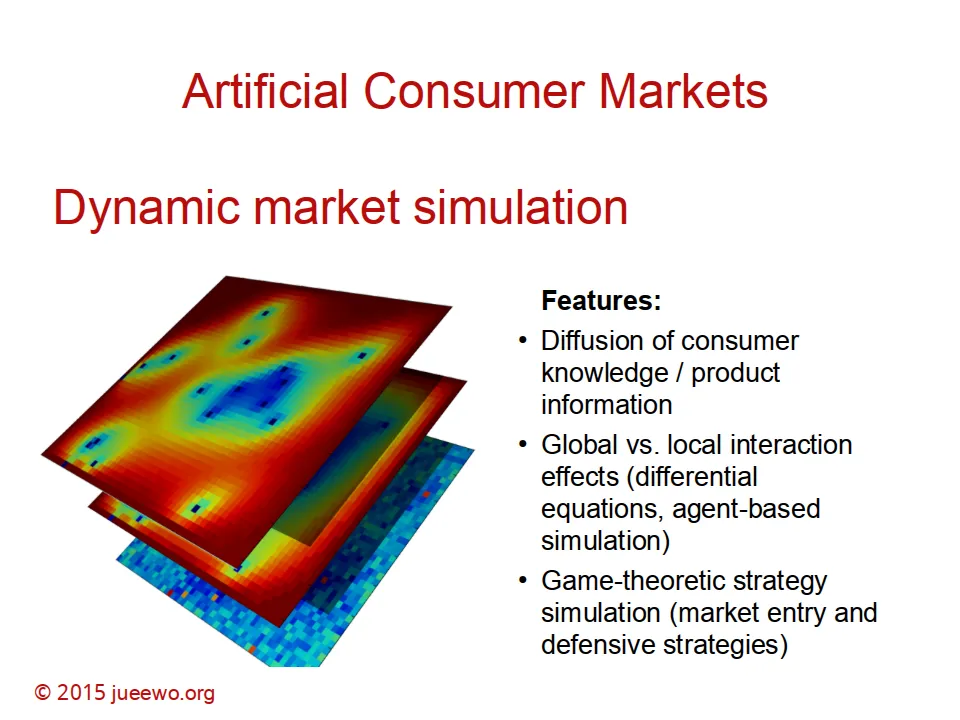
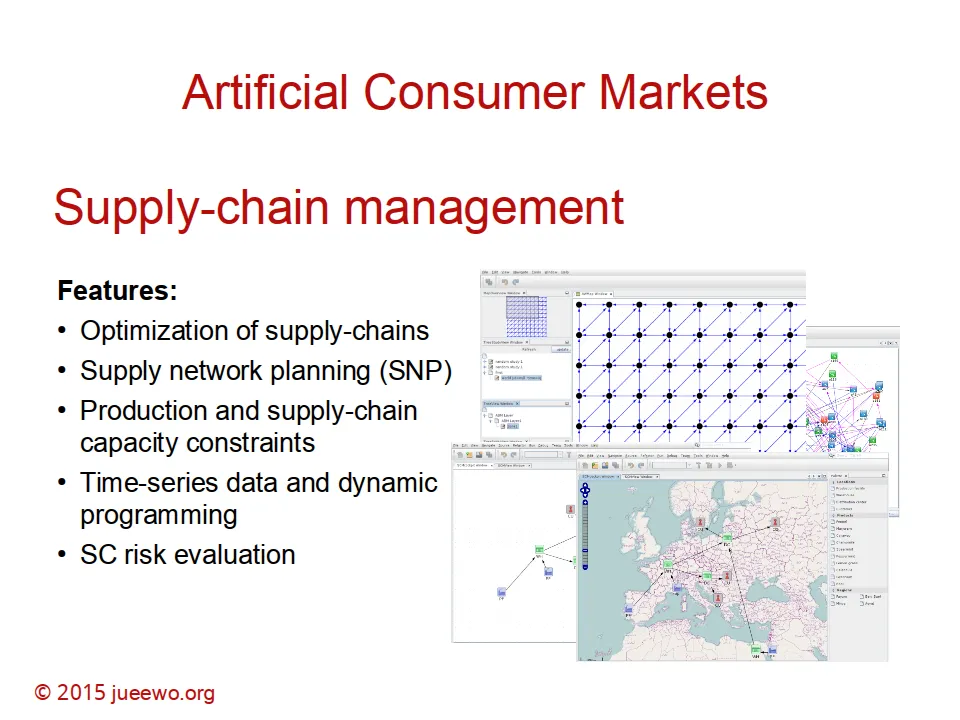
Features
Agent-based simulation
The core simulates diffusion of consumer knowledge and product information. Global and local interactions shape what counts as an optimal strategy.
Word-of-mouth
Communication is a local effect on product perception. Incentive structures change how knowledge spreads.
Network effects
Network structure and formation processes drive interaction dynamics. Without them the market story is incomplete.
Decision support
Simulation output supports master planning and strategy search. The core model also feeds adaptive learning in applied information systems.
Publications
Journal articles
- Wöckl, Jürgen. 2006. Modelling Artificial Consumer Markets. Simulation News Europe 44/45, 39–40.
- Schuster, U., Wöckl, J. 2005. Optimal Defensive Strategies under Varying Consumer Distributional Patterns and Market Maturity. Journal of Economics and Management, Vol. 1, No. 2, pp. 187–206.
Book chapters
- Wöckl, Jürgen. 2009. Interacting Advertising and Production Strategies – A Model Approach on Customers’ Communication Networks. In: Agent-Based Approaches in Economic and Social Complex Systems V, Terano et al. (eds.), 143–153. Tokyo: Springer.
- Mazanec, Josef, Schuster, Ulrike, Wöckl, Jürgen. 2006. Defensive Strategies and Consumers’ Bounded Rationality: An Artificial Market Simulation. In: Advances in Doctoral Research in Management, Vol. 1, Moutinho & Rita (eds.), 105–134. London: World Scientific.
- Schuster, U., Wöckl, J. 2005. A Continuous-Time ACM Model and Experiment. In: Taudes, A. (ed.), Adaptive Information Systems and Modelling in Economics and Management Science, Springer, Vienna–New York, pp. 45–56.
Conference proceedings
- Wöckl, Jürgen. 2007. Interacting Advertising and Production Strategies – A Model Approach on Customers’ Communication Networks. In: AESCS 07, Terano (ed.), 222–231. Tokyo.
- Wöckl, Jürgen. 2007. Modelling Advertising and Production Strategies using Cellular Automata. In: Proceedings of the 6th EUROSIM Congress, Zupancic et al. (eds.), 201. Ljubljana: ARGESIM / ASIM.
- Wöckl, Jürgen, Taudes, Alfred. 2006. A Hybrid Approach to Modelling Advertising Effects – An Application to Optimal Lying in Software Business. In: The First World Congress on Social Simulation, vol. 1, Terano (ed.), 175–182. Kyoto.
- Schuster, U., Wöckl, J. 2004. Optimal defense strategies under varying consumer distributional patterns and market maturity. AMS Annual Conference, vol. XXVII, pp. 140–144.
- Wöckl, J., Schuster, U. 2004. Derivation of stationary optimal defensive strategies using a continuous market model. AMS Annual Conference, vol. XXVII, pp. 305–311.
— Research note · lineage from ~2004–2009; card dated 2015 site archive.