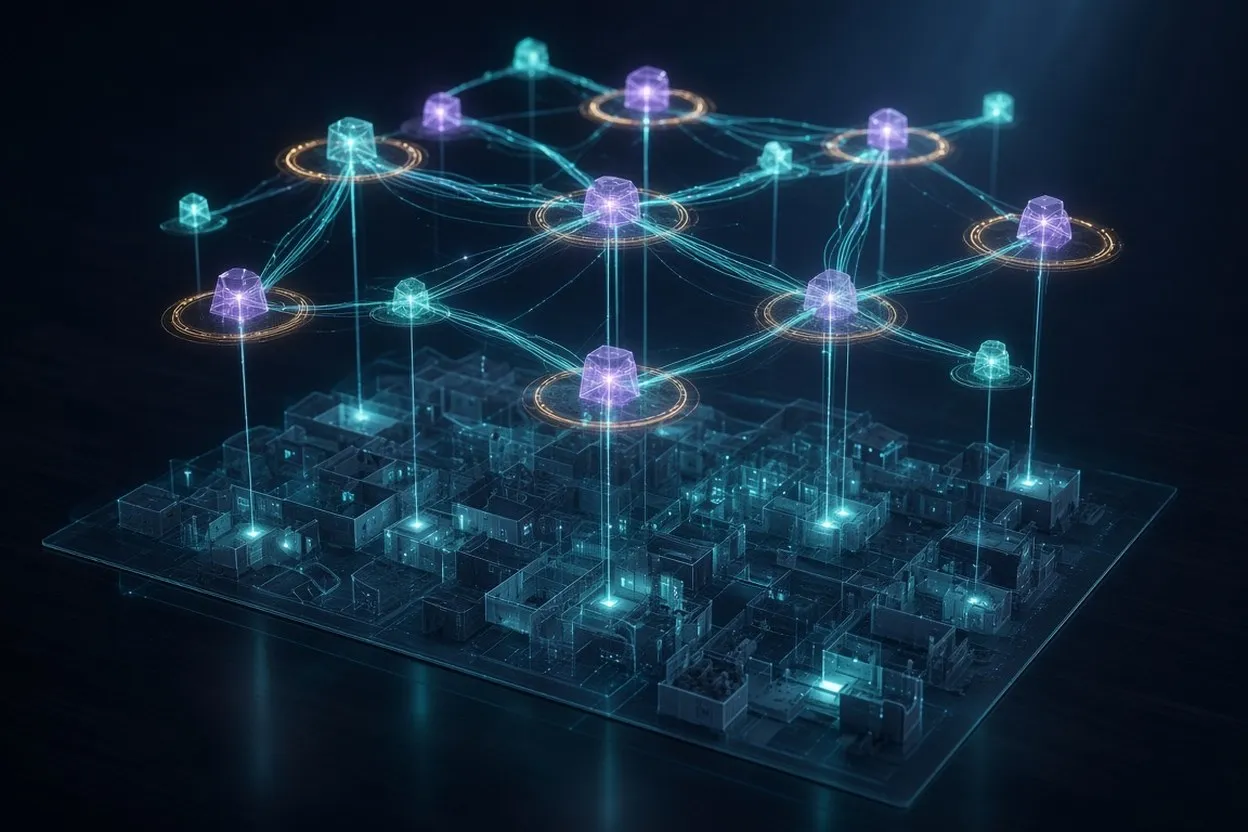
What the twin is
A digital twin of an operation does not have to begin as a geometric model. For maintenance, a shutdown, or any shared workplace, the useful twin is the current constraint picture: which resources are held, and which actions can no longer proceed because of that.
The structure is authored once, as a directed graph of actions and resources. The live state is the marking on that graph. A status event — an action becomes active, finishes, or is reopened — does not get copied by hand into every affected row. The status cascade computes the consequences. The twin shows the result.
Resources and actions
Two kinds of node are enough.
- A resource is something an action can lock or depend on: a room, a system, a piece of equipment, a permit, a shared capacity.
- An action is a piece of work. While it is active it may lock resources. It may also require other items to be available before it can honestly be treated as free.
Spatial placement stays in the model as a LOCATED edge: this item sits in that room or on that system. The edge is how an operator navigates the twin. It is not a dependency. Locking must not spread merely because two items share a location.
How one event updates the twin
The cascade is the update rule of the twin.
- An action enters an active status. Every resource it blocks records that action. The resource’s evaluated status becomes locked. If two actions lock the same resource, both remain recorded. Releasing one does not free it while the other is still active.
- Every item that requires a locked or already dependent item records that dependency. The walk continues upstream, along the require chain, up to a fixed depth. An action that needs a locked room, or that needs another action which itself depends on that room, is shown as dependent. Its own status is not overwritten.
- When the action leaves the active status, the records are removed in the same order. Empty lists fall back to the status that was set on purpose.
What the operator sees is the evaluated status: locked, dependent, or the status they set. The set status remains visible underneath a temporary lock. The twin does not invent an edge. It reads the graph that was authored.
A separate warning lists other actions whose locks overlap the resources this item transitively requires. That is a structural conflict, visible before the second action starts. It is not a forecast and it does not choose a sequence.
What the product does
The product concept is small.
- Author the operation as actions, resources, and the three edge types.
- Record status events as work starts and finishes.
- Let the cascade refresh the constraint picture.
- Keep scheduling, optimisation, and the safety case outside the twin.
The twin answers which resources are held and which actions are dependent right now. It does not answer who should go next, and it does not certify the plant. Those are different tasks, and they stay separate so the constraint picture remains checkable.